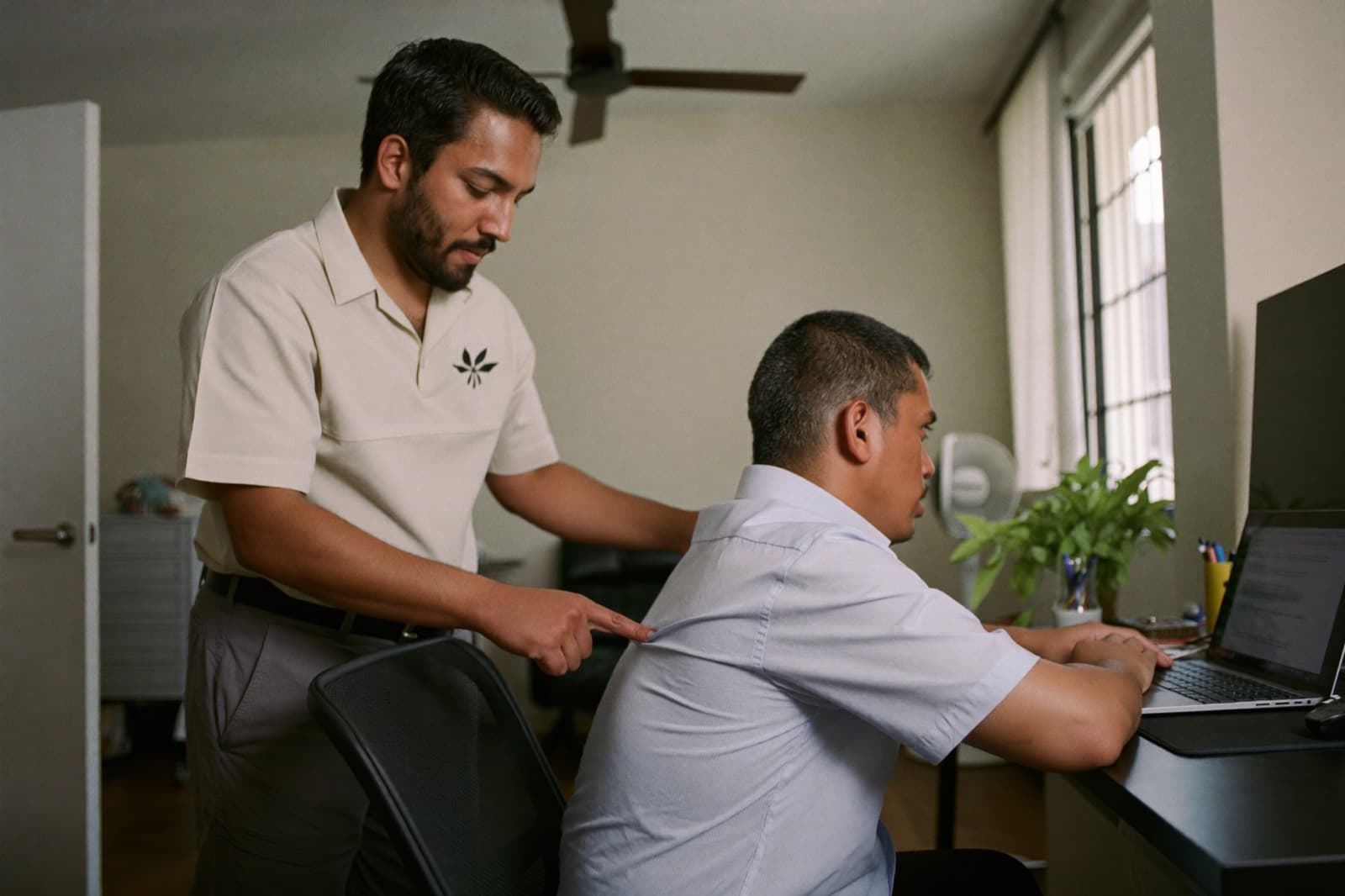
What actually happens in a home physiotherapy session
A first home visit is less mysterious than it sounds. Here is how the hour usually runs, what the physiotherapist needs from your space, and what you should have ready.

Most people booking their first home physiotherapy session have the same quiet worry: that their living room is not a clinic, and that whatever happens there will be a watered-down version of the real thing. It is a fair concern, and the answer is reassuring. For the majority of musculoskeletal and neurological conditions, the equipment that matters is the physiotherapist's hands, their assessment, and a floor space roughly the size of a yoga mat.
Here is how a typical hour runs.
Before the physiotherapist arrives
A good session starts with the notes you write when you book. The more specific you are, the less time gets spent on discovery when the physio walks in.
Useful things to mention:
- What hurts, where exactly, and for how long
- What triggered it, if you know: a fall, surgery, a bad night's sleep, gradual onset
- What makes it worse and what makes it better
- Any surgery, scan results, or a referral letter from a doctor
- Medication you are taking
- What you actually want to get back to: climbing your stairs, driving, prayer positions, lifting your child
That last point matters more than people expect. "Reduce pain" is a vague target. "Be able to kneel for prayer without bracing on the wall" gives the physiotherapist something to design around.
The first ten minutes: history
The session opens with conversation, not treatment. The physiotherapist is building a picture: onset, pattern, aggravating and easing factors, red flags that would mean referring you back to a doctor rather than treating you.
Expect questions that seem unrelated to the sore part. Shoulder pain that worsens at night, hip pain that started after a change in footwear, back pain that changes with your bowel habits: these details steer the diagnosis, and occasionally steer it away from physiotherapy entirely. A physiotherapist who screens carefully and tells you to see a doctor first is doing their job well, not avoiding it.
The assessment
Next comes the physical examination. Depending on the problem, this may include:
- Observation: how you stand, sit, walk, and move between the two
- Range of motion: how far a joint moves actively and how far the physio can move it passively
- Strength testing: resisted movements to find which muscles are underperforming
- Special tests: structured manoeuvres that make certain diagnoses more or less likely
- Palpation: feeling for tenderness, swelling, muscle tone and scar tissue
Home visits have a genuine advantage here. The physiotherapist sees your actual chair, your actual stairs, the height of your actual bed. Assessment in a clinic is a reconstruction of your life. Assessment at home is the thing itself, and it routinely surfaces the cause: a mattress that has given up, a workstation set 15cm too low, a step your knee cannot manage without twisting.
Treatment
This is where the largest part of the hour goes, and what it involves varies enormously by condition. Common components:
Manual therapy. Hands-on work: joint mobilisation, soft tissue release, stretching. This is usually what patients picture when they think of physiotherapy, and it is often the smallest part of long-term recovery.
Exercise prescription. The part that does the heavy lifting. You will be taught specific movements, corrected while doing them, and given a version to repeat between sessions. Expect a small number of exercises done well rather than a long list.
Education. Why the problem happened, what is safe to load and what is not, how long recovery realistically takes. Patients who understand their condition recover better than those following instructions blindly.
Modalities. Heat, ice, taping, or electrotherapy where portable. Supportive rather than central for most conditions.
What the physiotherapist needs from your space
Very little, but it helps to prepare:
- A clear floor area of roughly two by two metres
- A firm surface to lie on: a bed is workable, a firm mattress or a mat on the floor is better
- A sturdy chair without wheels
- Somewhere to wash hands
- Good lighting
- Loose clothing you can move in, and access to the area being treated
If you live with family, decide in advance whether you want someone in the room. For elderly patients and stroke rehabilitation, having the family carer present is genuinely valuable: they are the one supervising exercises for the other six days of the week.
The last five minutes
The session should not end when the treatment ends. Before the physiotherapist leaves, you should have:
- A clear home programme: which exercises, how many, how often
- An idea of what normal soreness feels like versus what should worry you
- A sense of how many sessions this is likely to take
- A plan for when the next visit should be
If any of those are missing, ask. Rehabilitation is mostly what you do between visits, and the programme is the part that carries.
Will it hurt?
Some techniques are uncomfortable: releasing a guarded muscle or mobilising a stiff joint after surgery is not always pleasant. But there is a meaningful difference between the productive discomfort of working into stiffness and sharp, protective pain. A physiotherapist should explain which they are aiming for, and stop when you ask them to. You are allowed to say stop.
How many sessions
It depends on the condition, and any honest practitioner will resist giving a number in the first ten minutes. As rough orientation: an acute soft tissue injury may resolve in three or four sessions; post-surgical rehabilitation typically runs weekly for several weeks and then tapers; neurological rehabilitation is measured in months. What should happen in every case is a reassessment, so both of you can see whether the plan is working.
That is the whole session. No waiting room, no travel, and for most conditions, no compromise.
This article is general information about physiotherapy and recovery, not a diagnosis or a treatment plan. Always consult a registered physiotherapist or doctor about your own condition.