Recovering at home after knee surgery: the first six weeks
The weeks after knee replacement or ligament reconstruction decide how good the final result is. A realistic look at what each phase involves and where home physiotherapy fits.
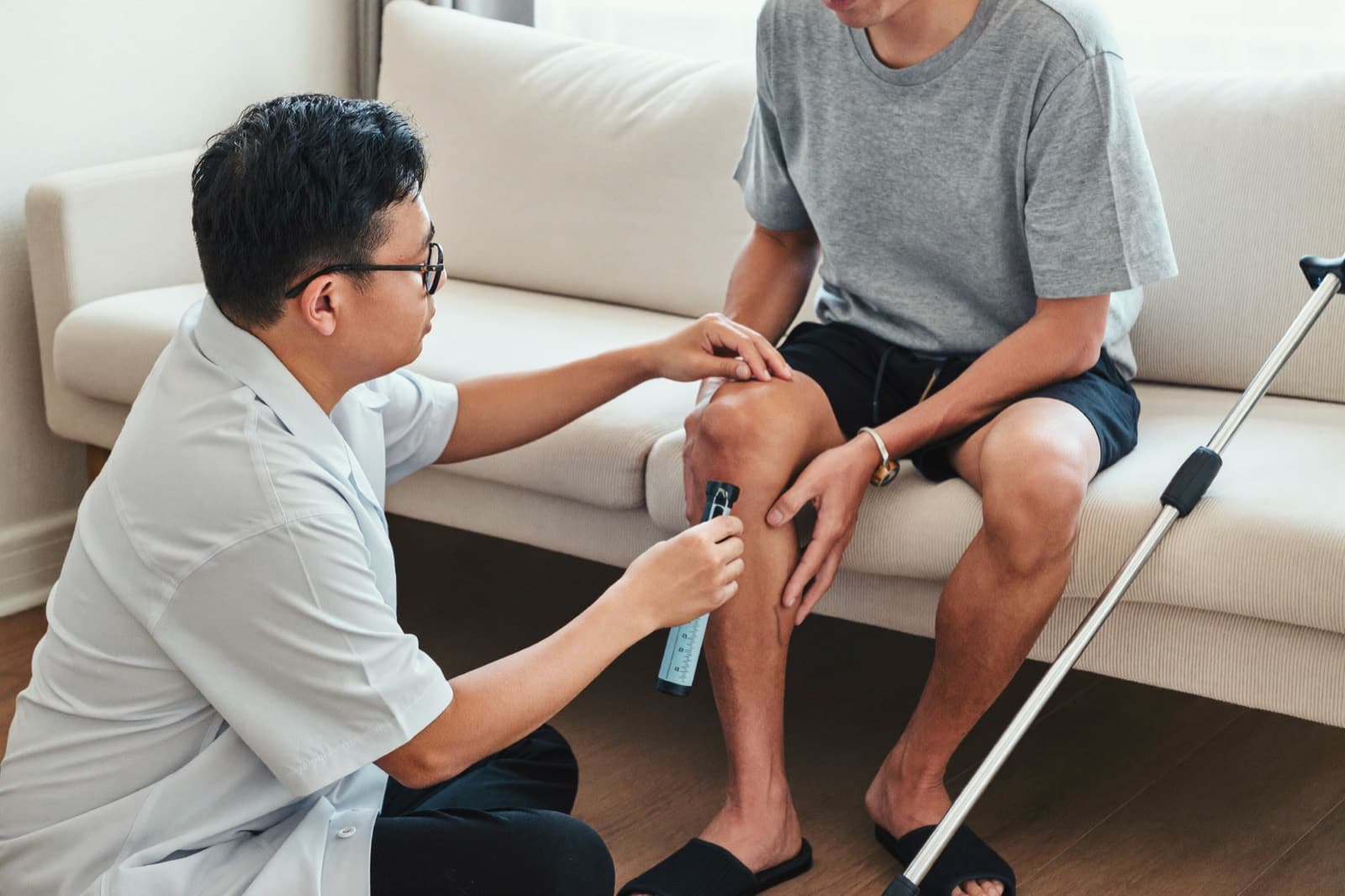
Knee surgery has a peculiar quality: the operation is the part everyone worries about, and the rehabilitation is the part that determines the result. Surgeons are fond of saying the operation is perhaps a third of the outcome. The rest is what happens in the following weeks, mostly at home, mostly without anyone watching.
This is a general orientation to that period. Your surgeon's protocol takes precedence over anything written here: protocols differ by procedure, by graft, and by surgeon.
The two common surgeries
Total knee replacement (TKR). Usually for advanced osteoarthritis. The priorities are regaining extension (getting the knee fully straight), then flexion (bending), controlling swelling, and rebuilding quadriceps strength. Weight bearing typically starts almost immediately.
Ligament reconstruction (commonly ACL). Usually in younger, active patients. The priorities are protecting the graft, restoring extension early, waking up the quadriceps, and then a long, patient build back to sport over many months.
Different operations, but the early principles overlap: get it straight, get it moving, get the swelling down, get the quadriceps firing.
Week 1: protect and activate
The first week is mostly about damage control and small, unglamorous wins.
What matters:
- Swelling control. Elevation above heart level, cold therapy as advised, and compression if prescribed. Swelling actively inhibits the quadriceps, so this is not merely about comfort.
- Extension. Full straightening is the single most guarded target in early knee rehabilitation. Extension lost in the first weeks is far harder to recover later, which is why physiotherapists are so insistent about it.
- Quadriceps activation. Static contractions, straight leg raises within your protocol. The muscle switches off after surgery and needs deliberate recruitment.
- Walking as prescribed. With whatever aid your surgeon specified, for short distances, frequently.
What home physiotherapy adds here: this is the phase where travelling to a clinic is hardest and most avoided. It is also the phase where the environment gets set up: bed height, chair height, where the ice goes, how the bathroom works, which route through the house is safest. A visit that sorts the house out pays back for six weeks.
Weeks 2-3: range and control
Sutures or clips come out, swelling starts to settle, and the work shifts.
- Flexion progression. Heel slides, seated knee bends, progressing towards the range your protocol targets. Most replacement protocols look for around 90° in the early weeks and continue improving from there.
- Gait retraining. Rebuilding a normal walking pattern rather than the protective limp. Left uncorrected, that limp outlives the recovery and creates hip and back problems.
- Progressive strengthening. Adding closed-chain work as permitted: sit-to-stand, partial squats within range, step work.
- Scar management. Once the wound is fully closed, gentle scar mobilisation keeps the tissue supple.
This is also when patients feel well enough to overdo it. A big day is regularly followed by a swollen, sore, stiff day. That fluctuation is normal, but a pattern of it slows progress. Physiotherapists spend a surprising portion of this phase telling motivated people to do less.
Weeks 4-6: function
By now, the goal moves from the knee to what the knee is for.
- Stairs, one step at a time then reciprocally, up and down
- Standing from low chairs and toilets without pushing through the arms
- Longer walking distances, weaning off aids as approved
- Balance and single-leg control
- Return to driving when your surgeon clears it and you can genuinely brake in an emergency
For ACL reconstruction, this is still early: the timeline to sport runs many months, and the temptation to rush is the main risk to the graft.
Warning signs
Contact your surgeon or seek medical attention if you notice:
- Calf pain, swelling, warmth or tenderness: possible deep vein thrombosis
- Fever, spreading redness, or discharge from the wound: possible infection
- Sudden severe pain, or a giving way with a pop
- Shortness of breath or chest pain: seek emergency care immediately
- Range of motion going backwards over several days rather than forwards
A physiotherapist should screen for these at every visit, but you are with the knee full time and will notice first.
What actually decides the outcome
Four things, in roughly this order:
- Extension, early. Protect it above almost everything else.
- Consistency. Short sessions several times a day beat one heroic session. Rehabilitation is a frequency game.
- Load management. Progress that respects swelling and pain response, rather than a schedule copied from someone else.
- Someone competent watching your technique. Compensation patterns are invisible from the inside. A well-executed heel slide and a badly executed one look identical to the person doing them.
That fourth point is the honest argument for home visits in this period. Not comfort. Supervision, during the exact weeks when getting to a clinic is hardest and when the technique matters most.
The realistic timeline
For a total knee replacement, most people are walking comfortably indoors within a few weeks, managing stairs and outdoor walking by six to twelve weeks, and continuing to improve in strength and comfort for a year or more. Progress is not linear and comparison with other patients is unhelpful: age, starting strength, the state of the other knee and any complications all shift the curve.
The recovery is long, occasionally frustrating, and rewards patience. Get it straight, keep it moving, control the swelling, and do the boring exercises when nobody is watching.
This article is general information about physiotherapy and recovery, not a diagnosis or a treatment plan. Always consult a registered physiotherapist or doctor about your own condition.